Full Sail, Finished: We Did It
A celebratory Full Sail Web Development reflection on finishing the degree, earning honors, and thanking the people who helped me get there.
Full Sail University's Web Development Bachelor of Science program changed how I build by forcing me to connect software decisions to product outcomes. It was not only a sequence of classes about HTML, CSS, JavaScript, APIs, databases, security, and deployment. It was a long pressure test of whether I could keep improving the way I plan, ship, explain, and maintain real web projects.
I completed the Web Development Bachelor of Science degree at Full Sail University in July 2026. Along the way, I was named Valedictorian for the Web Development Degree Program, received Full Sail's Advanced Achievement Award, earned four Course Director's Awards, and was recognized by the National Society of Collegiate Scholars for scholarship, leadership, and service.
Those distinctions matter to me, but not because they make the work complete by themselves. They matter because they reflect the same thing I was trying to build throughout the program: consistent execution, clear thinking, and the ability to turn a requirement into something real.
What I Earned
The final academic outcome was straightforward:
- Bachelor of Science in Web Development from Full Sail University, awarded July 31, 2026.
- Valedictorian, Web Development Degree Program.
- Advanced Achievement Award, Web Development Degree Program.
- Course Director's Award for Server-Side Languages.
- Course Director's Award for Project and Portfolio III: Web Development.
- Course Director's Award for Project and Portfolio IV: Web Development.
- Course Director's Award for Project and Portfolio V: Web Development.
- National Society of Collegiate Scholars recognition for scholarship, leadership, and service, presented November 2, 2024.
The degree represents completion of the program. Valedictorian represents academic standing. The Advanced Achievement Award means more to me because it is broader than grades. Full Sail describes it as a graduating-class distinction tied to overall effort, dedication, energy, sacrifice, skill, leadership, and program-wide performance.
The Course Director's Awards sit somewhere different. They are course-level recognition, and I am proud of where they landed. Server-Side Languages validated the backend work that helped push me from frontend implementation into application architecture. Project and Portfolio III, IV, and V validated the larger pattern I was trying to build: take what the program teaches, apply it under deadline pressure, and produce portfolio-grade work that can be explained after the assignment is over.
I do not see any of these as participation awards. I see them as evidence that I showed up consistently, took the work seriously, and improved in ways that were visible to the instructors evaluating the work.
Degree and Award Images
The images below are the degree and award records behind the academic honors referenced in this reflection.
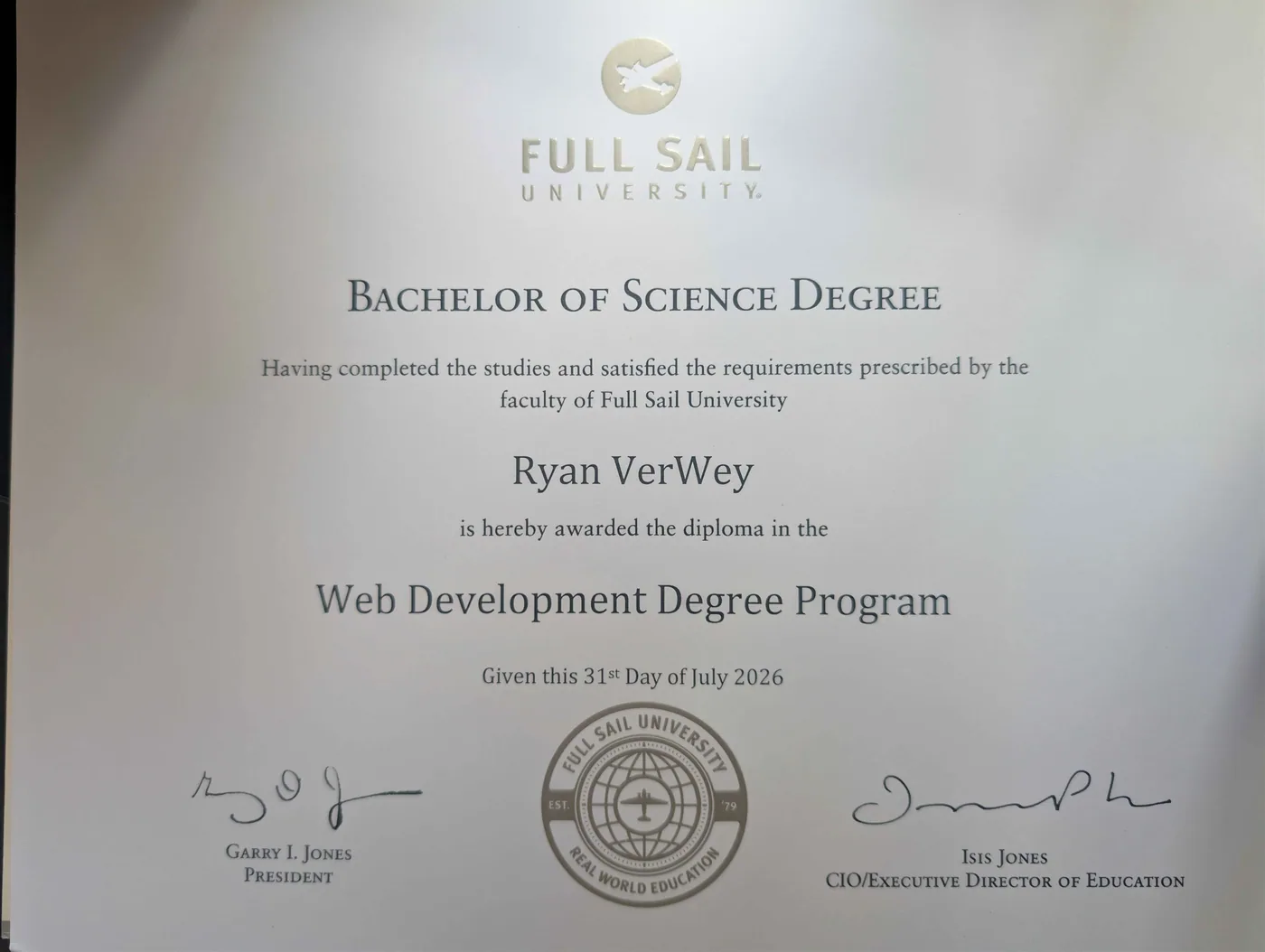
Bachelor of Science, Web Development Degree Program
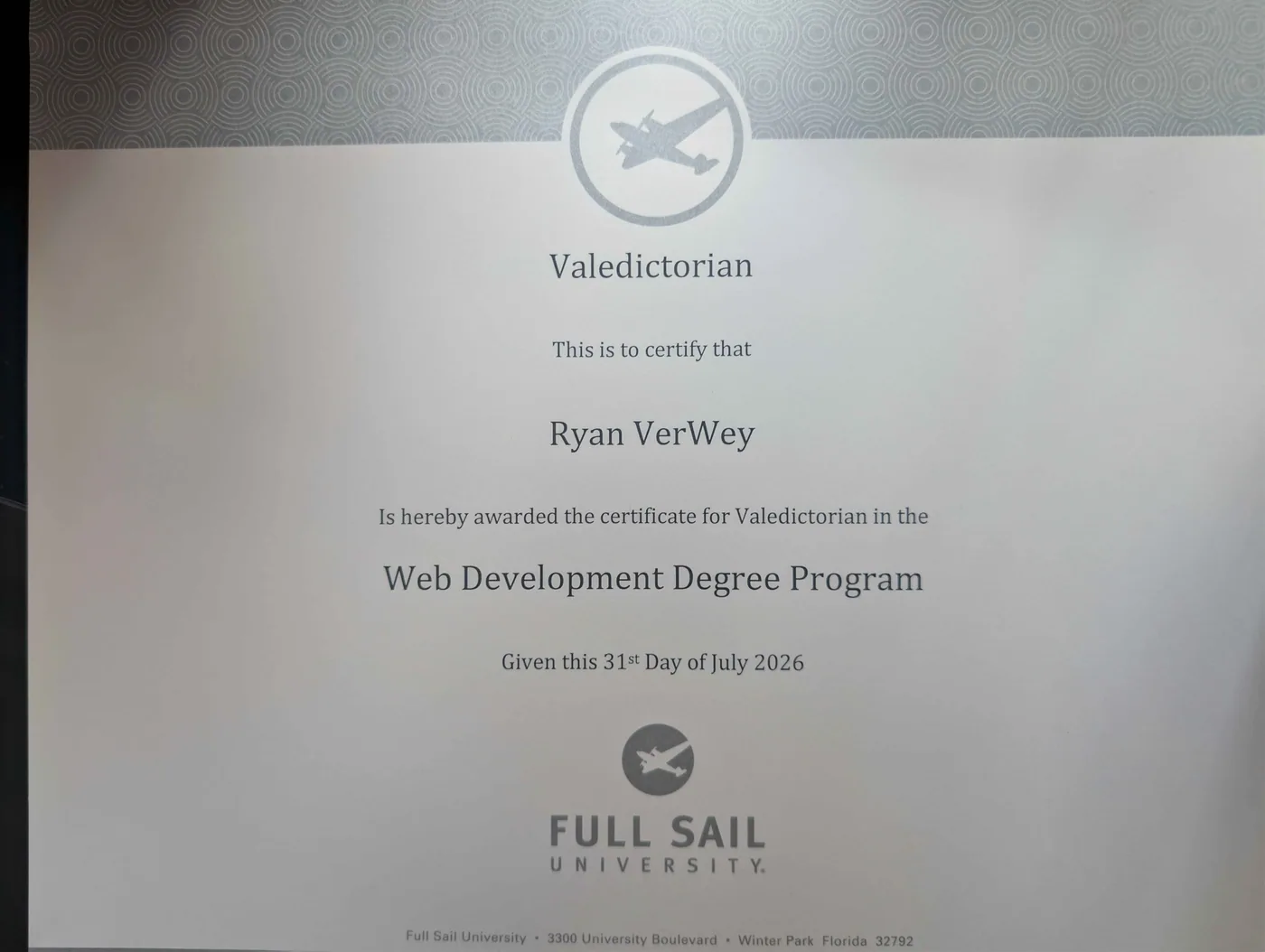
Valedictorian, Web Development Degree Program
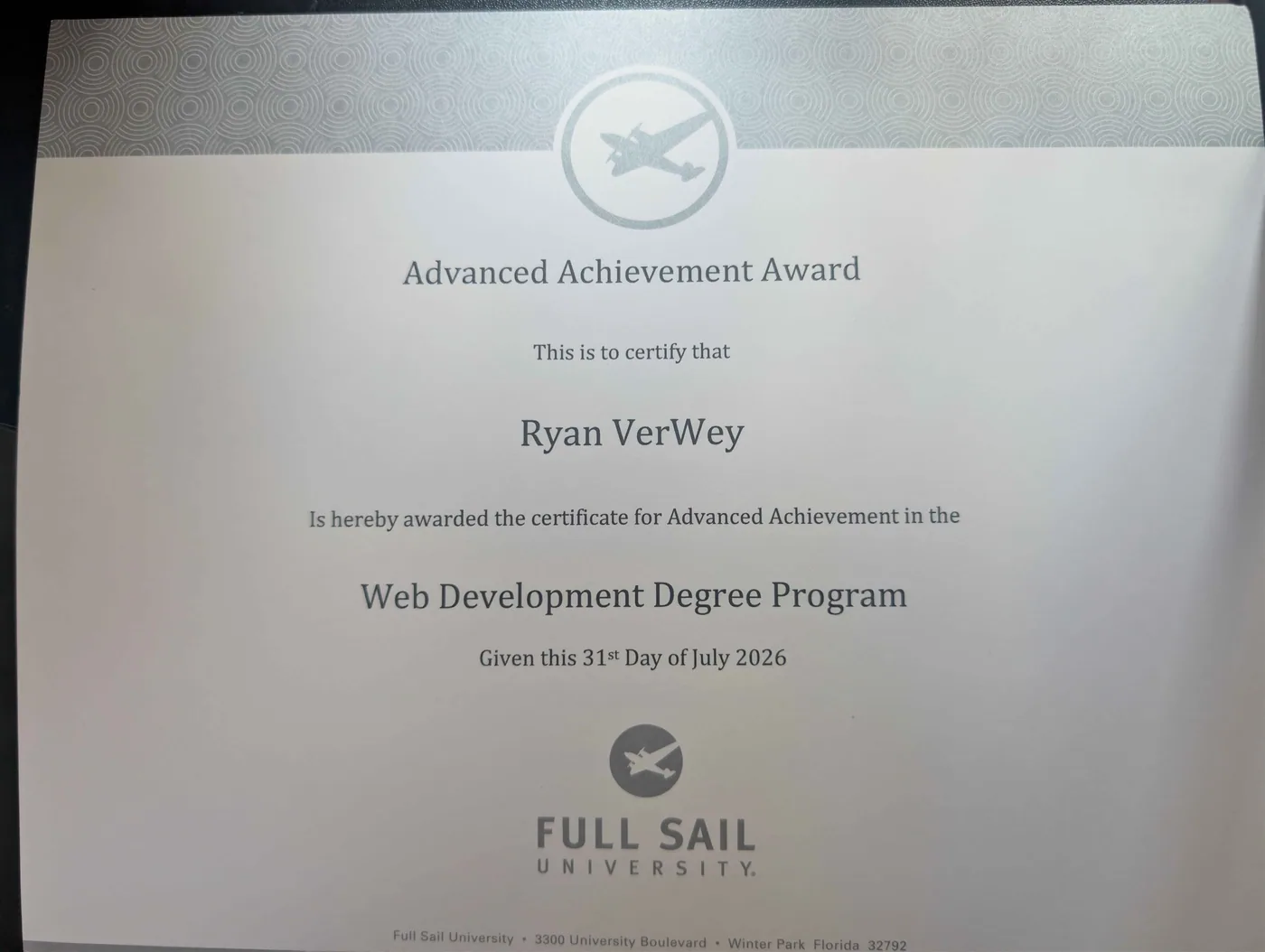
Advanced Achievement Award, Web Development Degree Program
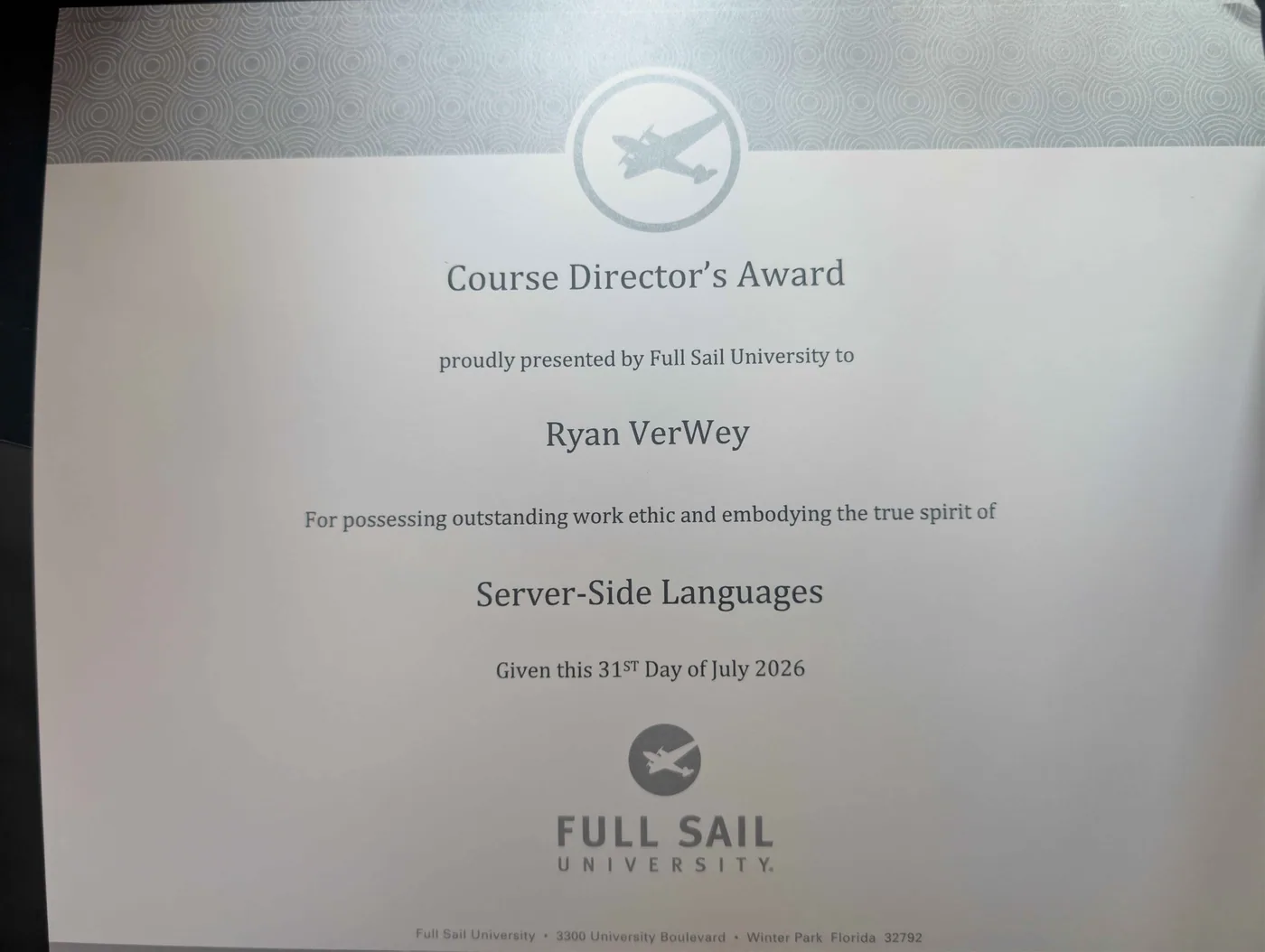
Course Director's Award, Server-Side Languages
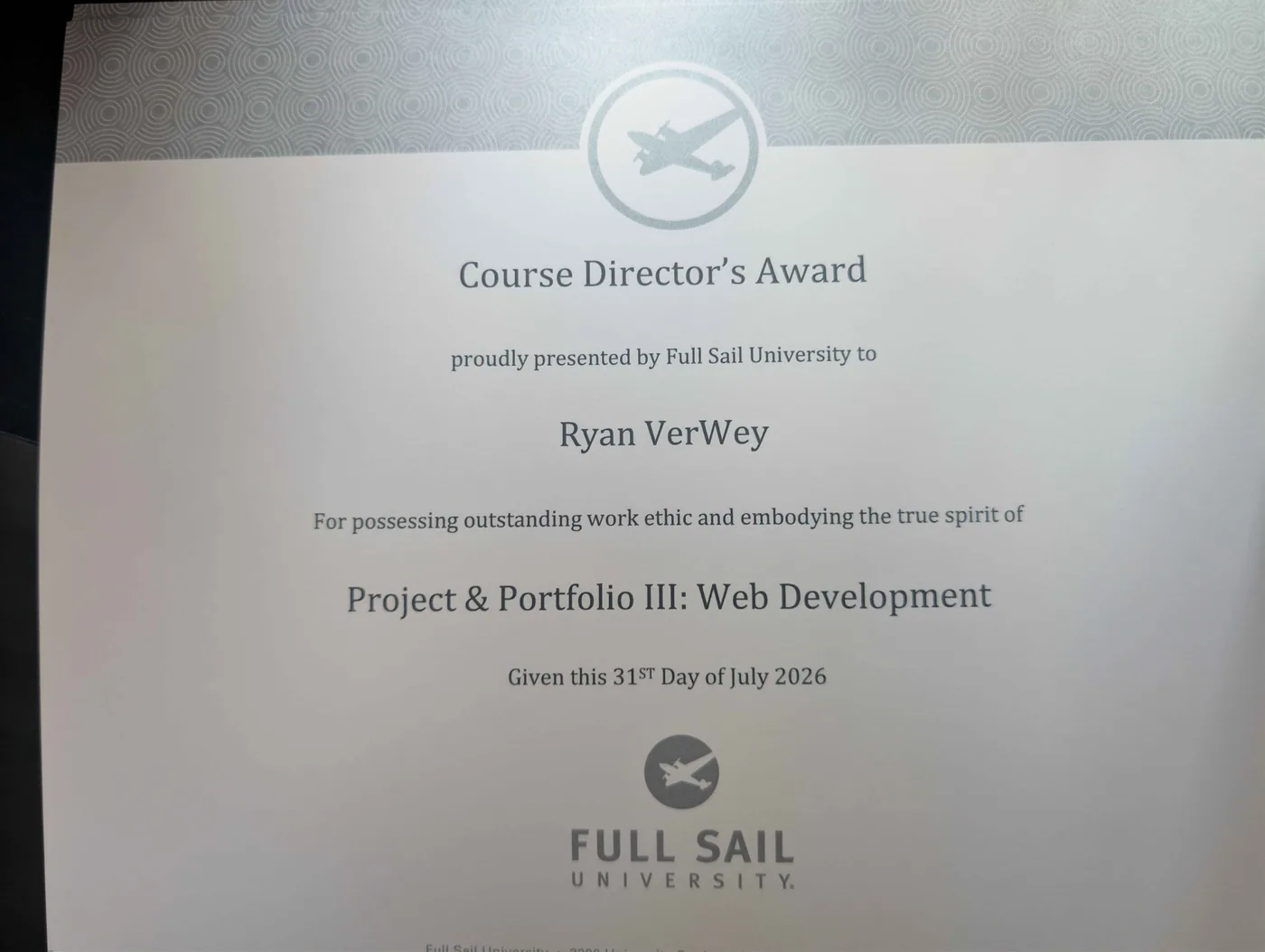
Course Director's Award, Project and Portfolio III
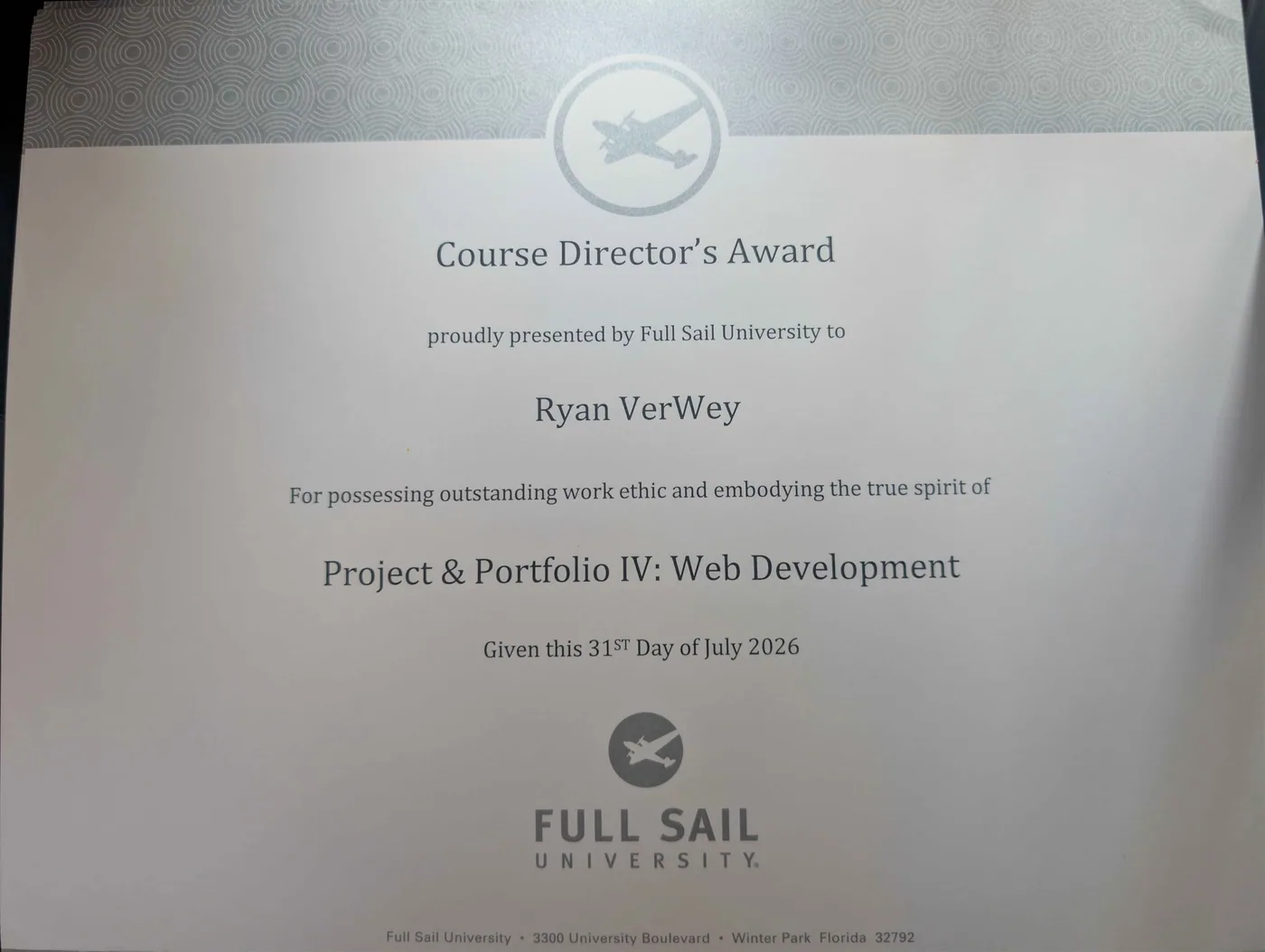
Course Director's Award, Project and Portfolio IV
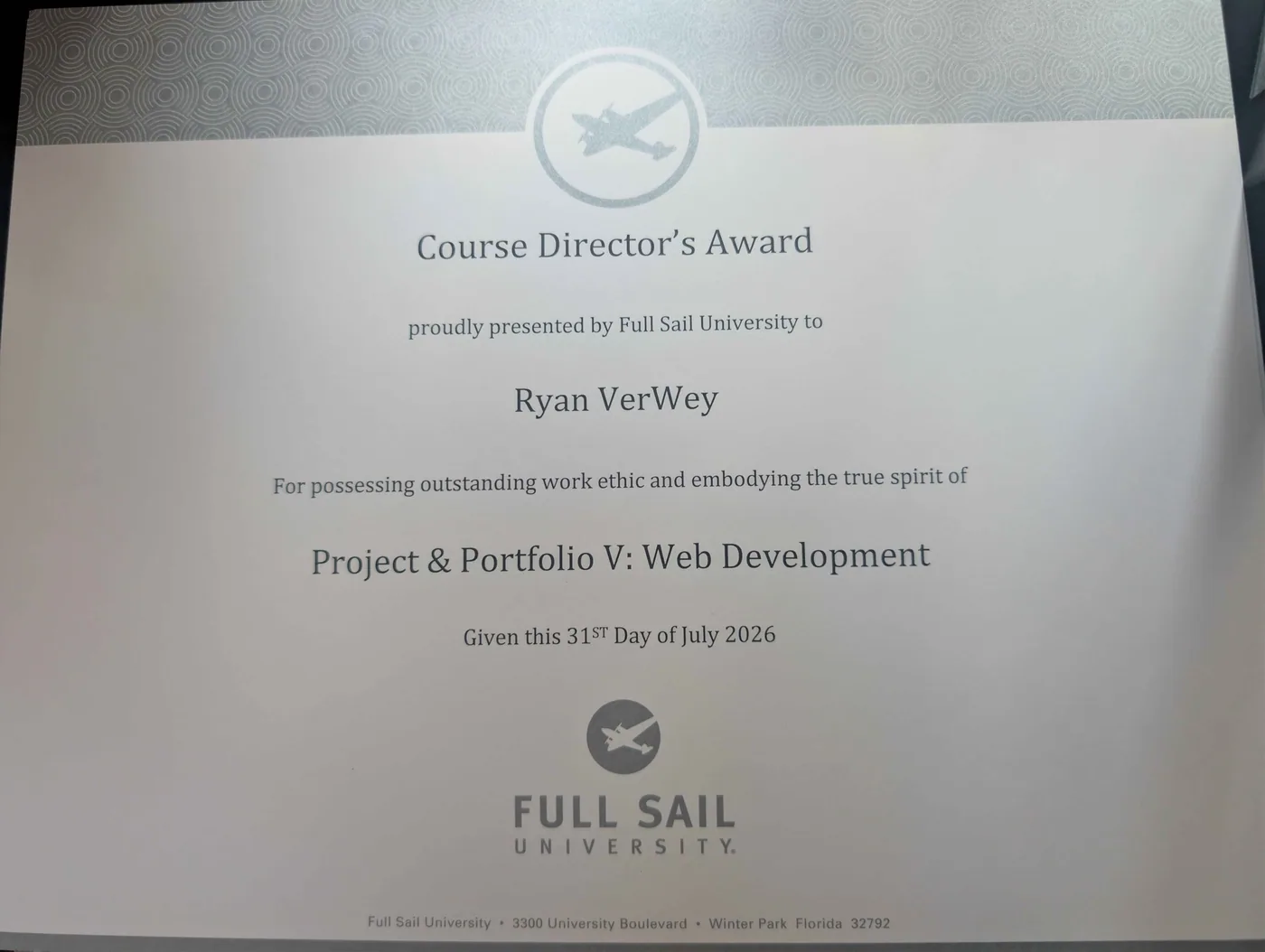
Course Director's Award, Project and Portfolio V
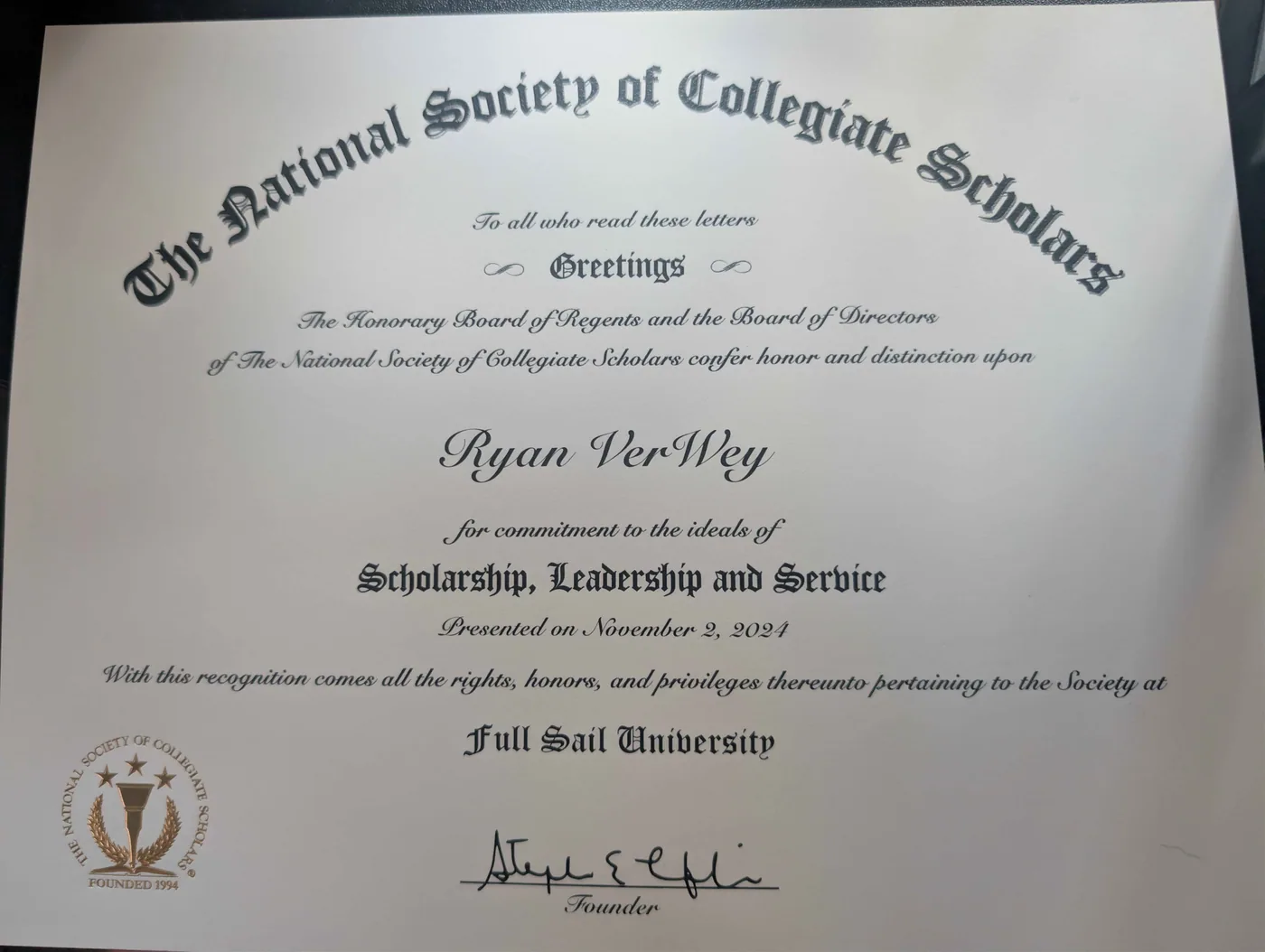
National Society of Collegiate Scholars recognition
The Program Was Not Just About Learning Syntax
It is easy to describe a web development degree as a list of technologies. That would be accurate, but incomplete.
The program did cover technical fundamentals. I worked through HTML structure, CSS layout, JavaScript logic, interface design, application state, backend routes, database models, authentication, deployment, testing, content management, security, and project delivery. Those topics matter. A web developer needs technical range.
But the more valuable shift was how those topics started connecting.
An interface is not separate from data modeling. A database decision affects the forms people use. Authentication affects the way a page should explain itself. Search engine optimization affects headings, routing, metadata, and content structure. Security affects input handling, deployment, secrets, and user trust. A portfolio is not just a gallery. It is a product surface that has to be usable, discoverable, credible, and maintainable.
That was the real growth for me. I stopped seeing web development as a collection of isolated skills and started seeing it as a system of tradeoffs.
Coming Into the Program With Real-World Pressure
I did not experience Full Sail in a vacuum.
I was already bringing a professional background into the program: military experience, geospatial intelligence work, contractor work, business ownership, team coordination, and the kind of operational habits that come from needing work to survive contact with real requirements. That background made the degree feel different.
When a course asked for a user interface, I was thinking about whether a user could actually make a decision from it. When a course asked for backend logic, I was thinking about where the data came from, who trusted it, and what would happen if it failed. When a course asked for a deployment, I was thinking about environment variables, hosting behavior, search visibility, and whether I could repeat the process later.
That professional context made school more valuable, not less. The assignments gave structure to things I had already started caring about. They forced me to slow down, name the decisions, and build a cleaner technical foundation underneath instincts I had picked up through work.
Full Sail did not erase what I already knew. It gave me a more disciplined way to express it as web development.
The Personal Cost Was Real
The clean version of this story is easy to write: I earned the degree, finished with honors, built a stronger portfolio, and moved into a clearer developer path.
That version is true, but it is not the whole truth.
For most of the program, I was not just a student. I was working at least two jobs, raising children, trying to keep my household moving, and still carving out enough focus to finish assignments at a standard I could be proud of. There were plenty of weeks where school did not fit neatly into life. It had to be wedged into late nights, early mornings, lunch breaks, weekends, and whatever quiet space I could find between work and family responsibilities.
That kind of pace takes a toll. It cost time. It cost rest. It cost energy I did not always have. At points, it cost pieces of my personal health because I kept choosing the long-term goal over short-term comfort. I do not want to romanticize that. Sacrifice sounds cleaner after the fact than it feels while you are living through it.
There were days when the work felt heavier than the assignment in front of me. A project deadline was not just a project deadline. It was stacked on top of work pressure, parenting, finances, fatigue, and the constant mental load of trying not to drop anything important. Finishing the degree required more than technical ability. It required endurance.
That is part of why the awards matter to me. They are not only academic decorations. They represent a period where I kept showing up while carrying a lot at once. They represent nights where I could have done the minimum and chose to push for better. They represent the discipline it took to build a new professional direction without being able to pause the rest of life.
In the end, it was worth it because the program gave me more than a credential. It gave me the start of a new life and a real career path as a developer. It gave shape to work I already cared about. It gave me a portfolio, a stronger technical foundation, a clearer professional identity, and proof that I could keep building even when the circumstances were not easy.
That is the part I will remember most.
Graduation Day
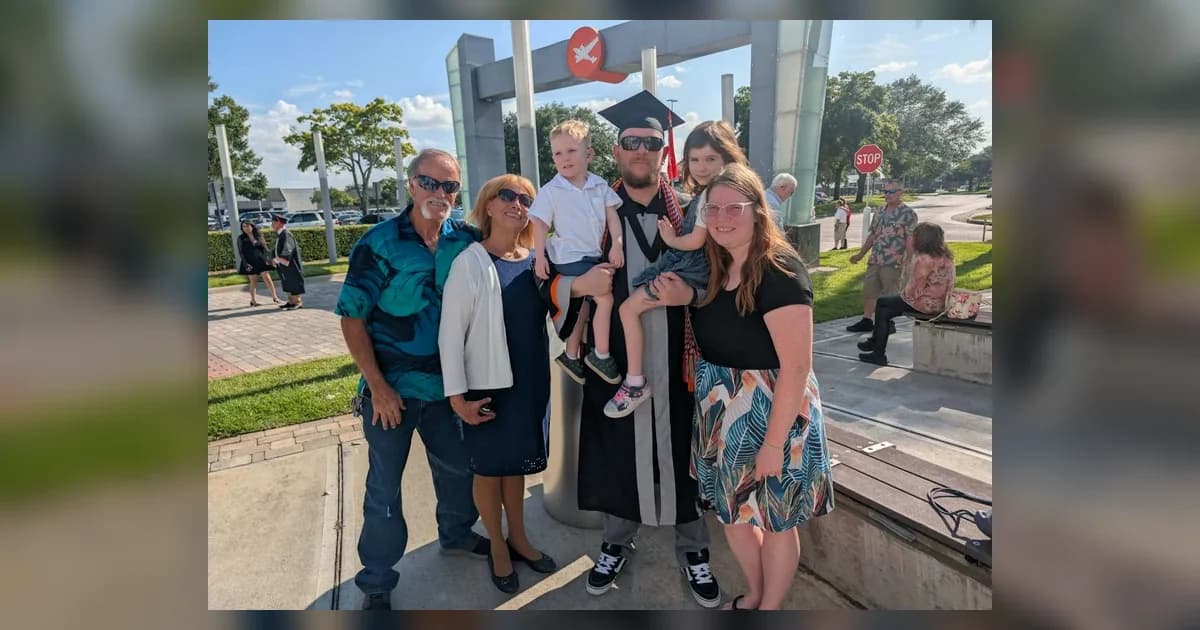
Graduation day made the sacrifice feel visible. The degree was mine, but getting there was never only an individual effort. My family lived through the long schedule with me: the work hours, the school deadlines, the late nights, the stress, and the constant balancing act it took to keep everything moving.
That picture matters because it shows what the program was really attached to. It was not just a career move on paper. It was a decision to build a different future while still being present for the people depending on me. That made the process harder, but it also made the outcome mean more.
The Early Courses Built the Mental Model
The first stretch of the program mattered because it established the mental model underneath everything else.
Introduction to Web Architecture made the browser feel less like a black box. HTML and CSS became structural tools instead of files that happened to make a page appear. Interfaces and Usability pushed that further by making design feel less subjective. Layout, hierarchy, spacing, contrast, and responsive behavior became part of how a product communicates.
The early JavaScript courses were where logic became more practical. Conditionals, loops, arrays, objects, functions, and classes are easy to describe academically. They become more meaningful when they start controlling actual behavior in the browser. The program gave me repetition there, and repetition matters. You do not become useful with JavaScript by watching someone else explain it. You become useful by writing it, breaking it, debugging it, and understanding why it broke.
Those early courses did not produce my most advanced projects, but they made the later projects possible. They built the habits that make larger systems easier to reason about.
The Portfolio Courses Changed the Standard
The Project and Portfolio courses were the backbone of the program for me.
Those courses changed the standard from "complete the assignment" to "produce something you can stand behind." That distinction matters. A normal class assignment can disappear after grading. A portfolio project has to explain what you can do.
Project and Portfolio I helped pull the early fundamentals together. Project and Portfolio II pushed deeper into React, API integration, data, and application behavior. Project and Portfolio III was where a fuller application started to emerge through authentication, profiles, blog features, project boards, and sprint planning.
Project and Portfolio IV raised the bar again by requiring more serious attention to access control, audit trails, cloud services, deployment, discovery, and postmortem work. Project and Portfolio V and Project and Portfolio VI became the launch path for Our Heritage Kitchen, moving it from product idea to beta planning, launch planning, search engine optimization, analytics, maintenance documentation, and handoff.
That sequence changed my expectations for my own work. By the end, I was not satisfied with a demo that technically loaded. I wanted clean user flows, readable content, meaningful metadata, deployment clarity, version history, maintainable structure, and enough written context that another person could understand what I built without a private walkthrough.
That mindset now shows up across my project portfolio, especially in the way I present live products, case details, technical stacks, and business context.
Backend Work Made Me Think in Systems
The backend courses were important because they moved me past interface-only thinking.
Server-Side Languages was one of the courses that stuck with me most. It helped make API design, routing, testing, MongoDB, Docker, and Node.js feel like part of ordinary product development. That Course Director's Award meant a lot because it marked a point where backend work was no longer just something sitting behind the interface. It became a core part of how I thought about building.
Advanced Server-Side Languages expanded that by pushing cleaner API architecture, TypeScript patterns, Express structure, WebSockets, and better service thinking. Database Systems added another layer by making persistence, backups, permissions, and database operations more explicit.
The practical lesson was simple: full-stack development is not frontend plus backend as separate piles of work. It is the ability to design the boundary between them.
That boundary affects performance, validation, security, user experience, analytics, and maintainability. It affects how clearly a feature can be tested. It affects whether the next developer can understand what the system is doing. It affects whether the user sees a coherent product or a collection of technical compromises.
Those courses strengthened the systems side of my work, and I still feel that influence when building tools, dashboards, design systems, and business-facing applications.
Security Changed How I Look at Ordinary Code
The security-related coursework helped me become more skeptical in a useful way.
Application Integration and Security introduced security pressure in a broader application context. Secure Application Development made it more direct: browser trust, cross-site request forgery, command injection, secrets management, JSON Web Tokens, deployment risk, and the responsibilities that continue after code leaves the local machine.
I do not market myself as a dedicated cybersecurity specialist. That is not the point. The point is that a full-stack developer cannot treat security as someone else's future cleanup task. The developer is often the person deciding how input is handled, where secrets live, how authentication works, how routes change data, how tokens move, and how deployment environments are configured.
That course changed the way I look at normal development decisions. When I see a request parameter, I think about validation. When I see a key or token, I think about storage and rotation. When I see a form that changes state, I think about intent. When I see a production deployment, I think about what the system is trusting.
That is not glamorous, but it is professional.
Content, Discovery, and Presentation Became Part of the Work
One of the more useful lessons from the later program was that software does not speak for itself.
Developers sometimes want the code to be enough. It rarely is. A project needs to be explained. It needs a purpose, an audience, a clear interface, useful metadata, and enough documentation that someone can evaluate it quickly.
That lesson has shaped this portfolio heavily. I care about search engine optimization, answer engine optimization, generative engine optimization, structured content, internal links, evidence, page hierarchy, and readable project summaries because discoverability is part of the work. If a recruiter, business owner, hiring manager, or AI search system cannot understand what a project demonstrates, then the project is not doing its job as a portfolio artifact.
My Full Sail retrospectives became part of that process. Each article helped package a piece of the program into something searchable and explainable. The goal was not to turn schoolwork into filler content. The goal was to document growth in a way that connects coursework to real capability.
That is why the Full Sail University learning journal exists. It gives the program a narrative arc instead of leaving it as a line item on a resume.
The Work Started Turning Into Real Products
By the end of the program, the work was not confined to class deliverables.
I was building and improving my own portfolio as a living system. I was building project pages that explain technical choices instead of just showing screenshots. I was writing articles that package decisions, constraints, and lessons learned. I was building tools through Echo Effect, experimenting with AI-assisted portfolio discovery, and turning design system work into something reusable.
That matters because professional growth is not only measured by the complexity of the code. It is measured by whether the code becomes useful.
Our Heritage Kitchen became a full product case study. CorvaUI became a design system direction with documentation and framework demos. Optimize became a website audit product focused on search, answer engine optimization, generative engine optimization, crawler access, accessibility, and prioritized repair planning. Rupert became a grounded AI assistant for helping visitors understand my portfolio. These projects are not all the same kind of work, but they share the same pattern: interface, logic, content, data, deployment, and communication all have to support the same outcome.
That is what Full Sail helped reinforce. Build the thing, but also make it understandable. Make it work, but also make it maintainable. Finish the assignment, but turn the learning into a reusable professional asset.
What Valedictorian Means to Me
Valedictorian is easy to explain from the outside: highest academic standing in the program.
From the inside, it feels more personal than that. It represents consistency. It means I kept the work moving across a long program while also carrying real life, real professional pressure, and a growing set of projects outside the classroom.
I am proud of the academic result, but I am more proud of the pattern behind it. Showing up every week matters. Reading the requirements carefully matters. Asking whether the work is actually good matters. Taking feedback seriously matters. Revising things that technically pass but do not meet your own standard matters.
That is the part I want people to understand when they see the word Valedictorian on my profile. It is not just a grade-point detail. It is shorthand for sustained execution.
What the Advanced Achievement Award Means to Me
The Advanced Achievement Award means something different.
Valedictorian is academic. The Advanced Achievement Award is broader. It recognizes the kind of student Full Sail views as standing out across the graduating class through performance, effort, leadership, skill, sacrifice, and the overall way they moved through the program.
That matters because software work is rarely judged on one dimension. Good grades are valuable, but professional trust comes from more than grades. It comes from communication, ownership, judgment, follow-through, and the ability to keep making progress when a problem is messy.
That is why this award hit differently for me. It felt like recognition of the whole pattern, not just the transcript. The late nights, the rewrites, the overbuilt first drafts, the cleaner second drafts, the projects that had to be shipped, the feedback I had to absorb, and the effort to keep raising the bar all counted.
Receiving that award alongside Valedictorian and multiple Course Director's Awards made the end of the program feel complete in a way I did not expect.
Course Director's Awards Were Signals Along the Way
The four Course Director's Awards gave me mile markers.
Server-Side Languages showed that the backend side of the program had clicked. That course required more than making buttons respond. It required routes, requests, responses, data, tests, and a clearer understanding of how applications behave away from the browser.
Project and Portfolio III showed that I could pull multiple disciplines into a real full-stack project. It was not just a technical checkpoint. It was a delivery checkpoint.
Project and Portfolio IV showed that I could revise and mature a project through access control, audit trails, cloud services, deployment thinking, and postmortem reflection.
Project and Portfolio V showed that I could move a larger product idea toward beta with business viability, metrics, compliance, security posture, versioning, release planning, and a stronger sense of product ownership.
Those awards do not replace the work. They point back to it. They mark moments where the work was strong enough to stand out.
How Full Sail Contributed to My Professional Growth
The biggest professional change was not that I learned a few more frameworks.
The biggest change was that I became more deliberate.
I became more deliberate about requirements. I started reading the assignment, project brief, or business need as a product contract instead of a checklist. What does the user need to do? What does the system need to prove? What does the page need to communicate? What will be hard to maintain later?
I became more deliberate about interfaces. A component is not just a styled block. It is a decision about hierarchy, state, accessibility, responsiveness, and user confidence.
I became more deliberate about backend logic. An API is not just a route. It is a boundary where trust, validation, persistence, and errors have to be handled clearly.
I became more deliberate about deployment. A deployed application is not finished if the environment is fragile, the metadata is weak, the handoff is unclear, or nobody can tell what changed.
I became more deliberate about writing. The ability to explain technical work is part of the work. A project without context is harder to evaluate, harder to trust, and easier to misunderstand.
That is the professional growth I value most. Full Sail gave me structure, deadlines, repetition, feedback, and a progression that pushed those habits into place.
What I Would Tell Someone Starting the Program
If I were talking to someone starting the Full Sail Web Development program, I would tell them not to treat the degree like a checklist.
The assignments matter, but the artifacts matter more. Every course can become something useful if you treat it as part of a larger portfolio. Write down what you learned. Keep the work. Improve it after the grade. Connect the course to a real project. Ask what the assignment is actually trying to teach, not just what needs to be submitted by Sunday night.
I would also tell them to build more than the minimum. Not recklessly, and not at the cost of missing requirements, but enough that the work becomes yours. The best learning I got from the program happened when I stopped asking "what is enough to pass?" and started asking "what would make this worth showing?"
That question changed everything.
What I Take Forward
I take forward a clearer identity as a developer.
I build full-stack products, design systems, AI-assisted tools, search-ready content, and business websites that need to work for real people. I care about interfaces, but I also care about the system behind them. I care about code, but I also care about whether the product can be found, understood, measured, and maintained.
Full Sail did not create that identity from nothing. It sharpened it. It gave me a structured path to prove it over and over again, course by course, project by project.
The final degree, Valedictorian honor, Advanced Achievement Award, Course Director's Awards, and National Society recognition are important because they document the outcome. But the more important result is practical: I left the program with a stronger standard for my own work.
That standard is what I am carrying forward.
A Few Acknowledgements
I owe Rachel more than a quick thank-you line can cover.
She carried the reality of this program with me, not just the idea of it. Every late night, every overloaded week, every deadline that landed on top of work and family life affected her too. She had to live with the schedule, the stress, the distracted evenings, the times I was physically home but mentally buried in code, documentation, deployments, or school requirements. Finishing this degree took effort from me, but it also took patience, grace, and sacrifice from her.
Rachel believed in the version of my life I was trying to build even when the day-to-day version of it was not clean or easy. She encouraged me when I was exhausted, gave me room when I needed to focus, and kept standing beside me through a process that asked a lot from our family. This degree is part of my professional story, but she is part of why I was able to finish it.
To Trinity and Alex, I hope one day this makes sense in a way that goes beyond seeing Dad on a laptop all the time.
There were nights, weekends, and ordinary family moments where school had to take space. I know that mattered. I know there were times when I had to ask for quiet, steal time, or push through one more assignment instead of being as present as I wanted to be. That is one of the hardest parts to write honestly because the goal was always for our family, but the work sometimes pulled me away from the very people I was doing it for.
I hope what you take from this is not that work should consume your life. I hope you see that hard things can be finished, that starting over professionally is possible, and that building a better future sometimes requires a season of sacrifice. I wanted you to see me finish. I wanted you to see that learning does not stop when you become an adult, a parent, or a provider. I wanted you to have proof that persistence can turn into something real.
To my friends and family, thank you for the encouragement, the check-ins, the patience, and the belief.
Support does not always look dramatic from the outside. Sometimes it is a message at the right time, a conversation that helps you reset, someone listening while you are frustrated, or someone reminding you that the work is worth finishing. Those moments mattered more than I probably said while I was in the middle of it. When life was crowded and the finish line still felt far away, encouragement helped keep the goal visible.
I also want to thank my Full Sail instructors for the mentorship, feedback, pressure, and structure they brought into the program.
The best instructors did more than grade submissions. They made the work feel connected to a professional standard. They pushed clarity. They rewarded effort, but they also expected execution. They treated projects like opportunities to think harder, communicate better, and build with more intent. Their feedback helped me see where an assignment could become a stronger product, where a technical choice needed a better explanation, and where "working" was not the same thing as being finished.
That mentorship mattered. It helped me turn coursework into portfolio work, portfolio work into professional direction, and professional direction into a stronger sense of what I want to build next.
FAQ
What degree did Ryan VerWey earn from Full Sail University?
I earned a Bachelor of Science in Web Development from Full Sail University. The degree was awarded on July 31, 2026.
What academic honors did Ryan VerWey receive at Full Sail University?
I was named Valedictorian for the Web Development Degree Program, received the Advanced Achievement Award, and earned Course Director's Awards in Server-Side Languages, Project and Portfolio III: Web Development, Project and Portfolio IV: Web Development, and Project and Portfolio V: Web Development.
What is Full Sail's Advanced Achievement Award?
The Advanced Achievement Award is a graduating-class distinction that recognizes a standout student across the full program. It is broader than grade-point average alone and reflects effort, dedication, energy, sacrifice, skill, leadership, and overall program performance.
What is a Course Director's Award at Full Sail University?
A Course Director's Award is course-level recognition from Full Sail faculty for standout performance in a specific course. In my case, those awards came from Server-Side Languages and three Project and Portfolio courses.
How did Full Sail contribute to Ryan VerWey's professional growth?
Full Sail helped connect technical skills to professional delivery. The program strengthened my work across frontend interfaces, backend logic, databases, security, deployment, testing, documentation, product planning, portfolio presentation, and search-ready content.
How does this reflection connect to the rest of Ryan VerWey's portfolio?
This reflection connects the Full Sail program to the broader portfolio. The course retrospectives live in my Full Sail learning journal, and the applied project work is collected on my projects page.
Related Reading
This post closes out my Full Sail University learning journal. For course-level detail, start with First Steps into Web Development, then follow the sequence through Server-Side Languages, Secure Application Development, Project and Portfolio V, and Project and Portfolio VI.
Share this article

Ryan VerWey
Full-stack developer, Army veteran, and founder of Echo Effect LLC. His experience timeline documents current Ratespedia CTO work, Department of War contractor work, and prior Army service. More about Ryan or see the work.
Recommended Reading
Project and Portfolio VI: Web Development at Full Sail University
Review Project and Portfolio VI at Full Sail, where Our Heritage Kitchen moved through launch planning, SEO, analytics, beta feedback, and handoff.
Going Further With Project and Portfolio II at Full Sail University
Review Project and Portfolio II at Full Sail, where I built a React application with API integration, MongoDB, CSS libraries, and a final showcase.
First Time Bringing It All Together at Full Sail University
Review Project and Portfolio I at Full Sail, where earlier web development skills came together through milestones and a working portfolio build.